Quick answer: If you are arriving in Indonesia by air or sea, including an international flight to Bali, complete the All Indonesia Arrival Card. It integrates customs, immigration, health and quarantine declarations, so you do not need a separate e-CD for the same arrival. Fill it out from three days before arrival and save your QR code for inspection. Indonesian Customs directs land-border arrivals to e-CD instead.
Customs guidance and portal checked on 4 November 2026. This guide focuses on baggage and declaration rules; our All Indonesia Arrival Card guide covers the full form and QR retrieval.
What Changed in 2025? Goodbye e-CD, Hello All Indonesia Arrival Card
The 2025 transition brought the All Indonesia Arrival Card into the arrival process. In 2026, the current Customs guidance directs air and sea arrivals to this unified service, combining immigration, customs, health and quarantine information.
Key changes:
All Indonesia replaces separate e-CD
Air and sea arrivals use All Indonesia; land-border arrivals use e-CD
For a normal international arrival at Bali airport, complete All Indonesia for your arrival declaration. Your visa and any applicable Bali Tourist Levy remain separate requirements.
All Indonesia Arrival Card
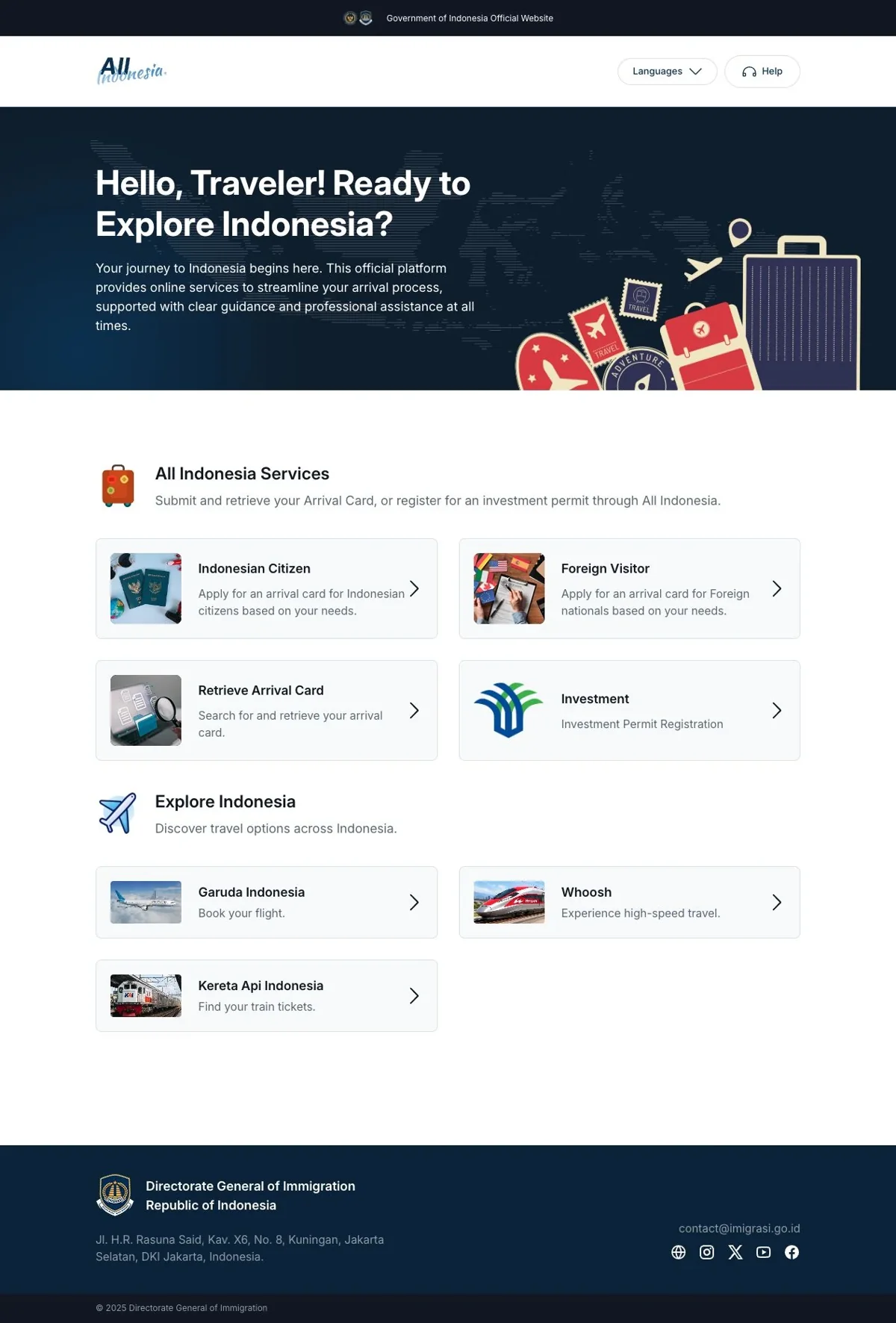
The All Indonesia Arrival Card (https://allindonesia.imigrasi.go.id/) is the free official arrival form for air and sea arrivals. It combines immigration, customs, health and quarantine information in one submission. Choose Foreign Visitor or Indonesian Citizen according to the passport you will use. You can complete it from three days before your scheduled arrival.
The official All Indonesia portal shows where to start an arrival-card application and retrieve an existing card. Screenshot captured on 3 November 2026. Source: Directorate General of Immigration — All Indonesia.
The four form stages are outlined below. The existing screenshots show an earlier interface; field wording and layout may vary. For screenshots of the current form, see our updated step-by-step All Indonesia guide.
Step 1: Fill in your personal information
Step 2: Fill in your travel details
Step 3: Fill in the mode of transportation and address
Step 4: Complete the Declaration stage (health, quarantine and customs)
Answer the declaration questions according to what you actually carry. Review your details before certifying and submitting the form, then save the QR code offline for inspection. If you cannot find it later, use Retrieve Arrival Card on the official portal; our All Indonesia guide shows the retrieval process.
Things You Can Bring and Cannot Bring Into Indonesia
Indonesia uses a combination of duty-free allowances and prohibited/restricted goods rules. The official Customs passenger-goods guidance explains the rules under Ministry of Finance Regulation No. 34 of 2025, amending No. 203/PMK.04/2017 on goods carried by passengers and crew.
Below is a traveler-friendly summary (not legal advice). If in doubt, declare it.
What you can bring
These are the typical allowances per person for passengers arriving in Indonesia:
Personal goods and shopping
Duty-free value up to USD 500 per person for personal use items (clothing, electronics, gifts, etc.).
For ordinary personal-use goods above the USD 500 exemption, Customs lists 10% import duty on the excess value, plus VAT and any applicable luxury-goods tax. Its current passenger guidance excludes personal-use passenger goods from income-tax collection (PPh). Different treatment can apply to non-personal or commercial goods.
Tobacco & alcohol (for adults)
Alcoholic beverages containing ethyl alcohol: maximum 1 liter per passenger aged 21 or older.
Tobacco products:
Cigarettes: up to 200 sticks
Cigars: up to 25 sticks
Rolled tobacco: up to 100 grams
Other processed tobacco products: up to 100 grams or equivalent
Solid e-cigarettes: up to 140 sticks or 40 capsules
Open-system e-cigarette liquid: up to 30 mL
Closed-system e-cigarette liquid: up to 12 mL (passengers must be 18 years or older)
Note: If a passenger brings more than one type of taxable tobacco product, the duty-free allowance is applied proportionally across all items.
Personal electronics & gadgets
Phones, laptops, cameras, and similar personal devices used during travel are usually allowed as personal effects, as long as quantities are reasonable for personal use (not multiple identical new devices in boxes). Customs directs travellers bringing foreign-purchased phones, handheld computers or tablets for permanent use in Indonesia to declare them for IMEI registration through All Indonesia. Check your intended use before arranging permanent registration.
Prescription medicine (for personal use)
Reasonable quantities of medication for personal treatment, ideally with:
Prescription or doctor’s letter
Medicine in original packaging
Check the applicable medicine-import restrictions before travelling, especially for controlled ingredients. A prescription does not automatically make every medicine admissible, and any required permit must be obtained in advance.
Cash & monetary instruments
You can bring in cash, traveler’s cheques, or similar instruments.
Cash and specified payment instruments worth IDR 100 million or more (or the equivalent) must be declared. Additional rules apply to large amounts of foreign banknotes; declaration alone does not replace any required approval. Check the current official cash guidance for your currency and instruments.
What you cannot bring
Some items are strictly prohibited, while others are restricted and require prior permits. Check the official prohibited and restricted goods guidance for your specific item; the examples below are not an exhaustive list. Declaring an item does not replace a required import permit.
Prohibited or strictly controlled items
Narcotics and illegal drugs (very serious penalties, including long prison terms or death penalty)
Firearms, ammunition, explosives, and related parts (unless specially authorized)
Certain endangered wildlife products protected by CITES (e.g., ivory, some shells, animal skins, certain traditional medicines)
Restricted items (declare and often need permits)
Large quantities of perfume, cosmetics, or branded fashion that look like commercial inventory
Fresh food, meat, plants, seeds, and agricultural products (subject to quarantine and health regulations)
Professional equipment (e.g., full camera crews, sound equipment, tools) intended for work or commercial activity
Medical equipment, lab materials, or high-value professional electronics
Goods exceeding allowances
Declare goods exceeding the applicable allowances. Ordinary shopping and excise goods have different consequences:
Ordinary personal-use goods over USD 500 per person: the excess value is subject to the applicable import duty and taxes.
Alcohol beyond the applicable 1-liter passenger allowance: Customs states the excess is destroyed.
Tobacco beyond the applicable allowance (including proportional limits for mixed tobacco products): Customs states the excess is destroyed.
Multiple new identical items (e.g., five new iPhones still in plastic wrap) may be assessed as non-personal or commercial goods, with different rules.
Undeclared excess goods can be seized, confiscated, or fined.
What Happens If You Don’t Fill In the Customs Declaration
Failing to submit your customs declaration can cause immediate issues on arrival. Customs officers may stop you, question you, and send you to the inspection area.
If you bring goods that should have been declared (such as restricted items or anything above the duty-free limit) your belongings can be taken, and fines may apply. Customs has the authority to seize items on the spot.
Serious violations have harsher outcomes. Carrying prohibited substances or attempting to hide goods can lead to criminal charges or deportation. When unsure, ask Customs before travelling and declare accurately. Submitting an arrival card does not guarantee that every item is admissible or duty-free.
Tips for a Fast and Easy Customs Process in Indonesia
A bit of preparation can save you a lot of time at the airport.
Complete All Indonesia before you fly
Complete it from three days before scheduled arrival, check all details (passport number, flight, accommodation and baggage declarations), then save the QR code offline.
Keep documents ready in one place
Passport
Boarding pass
Visa / e-VOA approval (if applicable)
Bali Tourist Levy voucher or applicable exemption evidence (if visiting Bali)
All Indonesia QR code
Know your duty-free limits
Check the applicable tobacco and alcohol limits before packing, including proportional limits if you mix tobacco products. Excess alcohol or tobacco is subject to destruction, not simply an extra tax payment.
Separate personal items from commercial goods
Keep your personal clothes and gadgets in regular luggage.
If you’re bringing items for business (samples, stock), pack and declare them separately.
Prepare for random checks
Even with a green-channel exit, officers may randomly scan or open bags. Stay calm, answer questions clearly, and show your declaration QR code.
Avoid bringing risky items
Leave illegal drugs, weapons, pornographic material, and questionable “souvenirs” at home. Indonesia is extremely strict on these categories.
Declare large amounts of cash
If you bring cash or specified payment instruments worth IDR 100 million or more (or equivalent), declare them and check any additional rules or approvals before travelling.
Need Help Planning Your Trip to Indonesia/Bali?
Indonesia’s customs declaration is just one part of entering the country smoothly. You also need to think about:
With Indonesia’s entry procedures evolving, it can be challenging to keep track of what’s required. Visa BaliEasy is here to make everything straightforward. Our team guides you through the right visa options, ensures your documents are prepared correctly, and provides quick assistance if you face any issues on arrival.
Travel with confidence knowing you’ve got a trusted local expert handling the formalities, so your trip starts smooth, stress-free, and exactly the way you planned.